

![[subpage-banner/2_pamatkyaexpozice_1.png]](https://c.jewishmuseum.cz/images/subpage-banner/2_pamatkyaexpozice_1.png)
Pinkas Synagogue: Shoah Memorial in the Heart of Prague
The Pinkas Synagogue is the second-oldest extant synagogue in Prague and one of the most powerful sites on the Jewish Museum’s circuit.
Dating from 1535, the synagogue was built in a late Gothic style by one of the leading members of the Prague Jewish community, Aaron Meshulam Horovitz. It was probably named after the latter’s grandson, Rabbi Pinkas Horovitz. The building originally served as a private house of worship. A ritual bath (mikveh) was located nearby. Between 1950 and 1954, the synagogue was restored to its original appearance.
The synagogue is now a profoundly moving Shoah memorial, on whose interior walls are inscribed the names of about 80,000 Jewish victims from Bohemia and Moravia. It serves as a reminder of what must never be forgotten.
History and architecture
-
1492: A small house of worship was founded on the site of the Coats of Arms House.
-
1535: The building was expanded by the Horovitz family – marked by a commemorative plaque in the vestibule.
-
Early 17th century: The builder Judah de Herz added a women’s gallery, vestibule, and entrance hall. The synagogue has late Gothic features combined with an early Renaissance portal. The interior is illuminated by five windows with stone traceries. The walls are adorned with pilasters and decorative paintings in the style of Renaissance plasterwork.
-
1860: As a result of flood damage, the floor level of the main hall was raised by 1.5 meters.
-
1960: The Shoah memorial was opened
-
2002: The nave was damaged by flooding up to 1.3 meters deep
-
2003: The building reopened after reconstruction
Shoah memorial
Thanks to the efforts of the first post-war director of the museum, Hana Volavková, the Pinkas Synagogue was transformed between 1955 and 1960 into a memorial to the nearly 80,000 Czech and Moravian Jews who became victims of the Shoah. One of the oldest memorials of its kind in Europe, it was created by the painters Václav Boštík and Jiří John. Following the Soviet invasion of Czechoslovakia in 1968, the memorial was closed for more than twenty years. It was not until 1995 that it was reopened after full-scale reconstruction. For more on the exhibition.
Digital interface
isitors exploring family history or the Shoah in the Czech lands may access a digital interface that presents not only the names of victims but also available digitized documents associated with each individual.
Symbolism of the space
On either side of the Torah ark (Aron ha-Kodesh) are the names of ghettos and camps – the destinations of deportation transports from the Czech lands.
At the center of the main nave stands a stone bimah – the focal point of the prayer hall – enclosed by a Rococo grille adorned with motifs of the Star of David and the Jewish hat. This grille was donated by Joachim Popper.
Exhibition of children’s drawings from Theresienstadt
The upper floor houses a permanent exhibition of children’s drawings from the Theresienstadt ghetto (1942–1944) which was added to UNESCO’s Memory of the World Register In 2025. Cared for by the Jewish Museum in Prague, this unique collection of 4,387 drawings represents an invaluable record of children’s lives in the ghetto. More than 10,000 children under the age of 15 passed through Theresienstadt. The drawings depict life before deportation, the transports, dreams and everyday reality, and are often the only trace left by children who never returned.
Visitor information
-
Part of the sightseeing circuit: Prague Jewish Town
-
Wheelchair access: partial
-
Services: ticket office, audio guide rental
Visit the Pinkas Synagogue in Prague – a unique monument and a place of historical memory
Programme
Memorial and commemorative events.
Video & 3D tour
Where to find us
Široká 3, 110 00, Prague 1
Frequently asked questions
What is the main attraction here?
The memorial listing nearly 80,000 names of Holocaust victims from Bohemia and Moravia.
Is there anything else to see?
Yes, the upper floor displays drawings by children from the Terezín ghetto.
Is the atmosphere different from other synagogues?
Yes, it is a quiet memorial space intended for reflection.
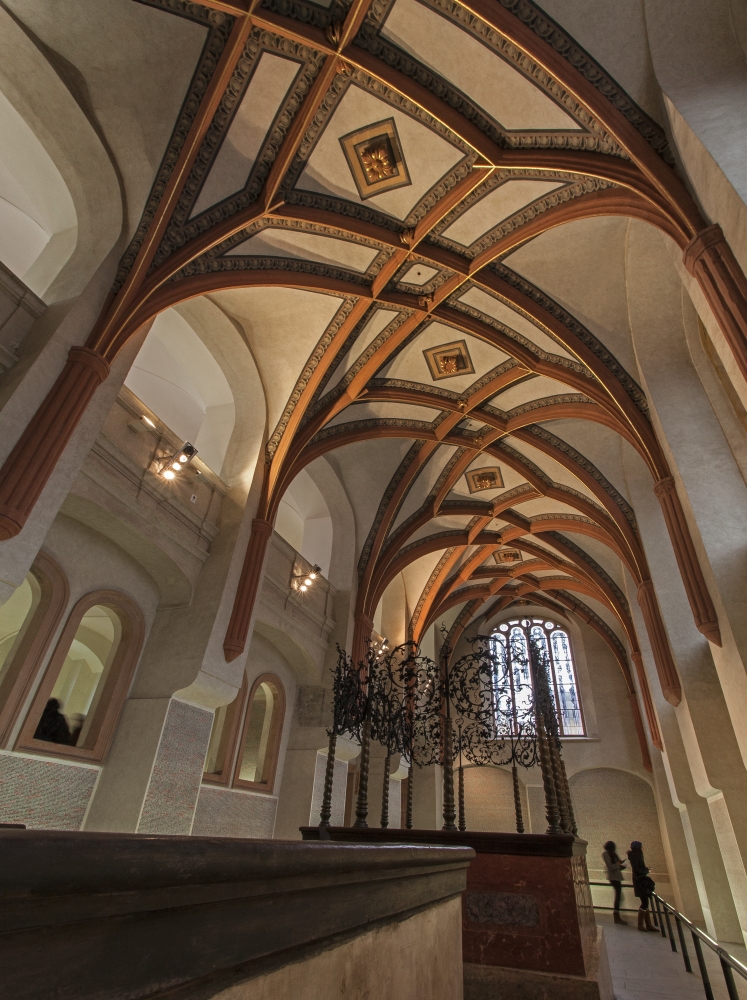
Pinkasova synagoga / Pinkas Synagogue
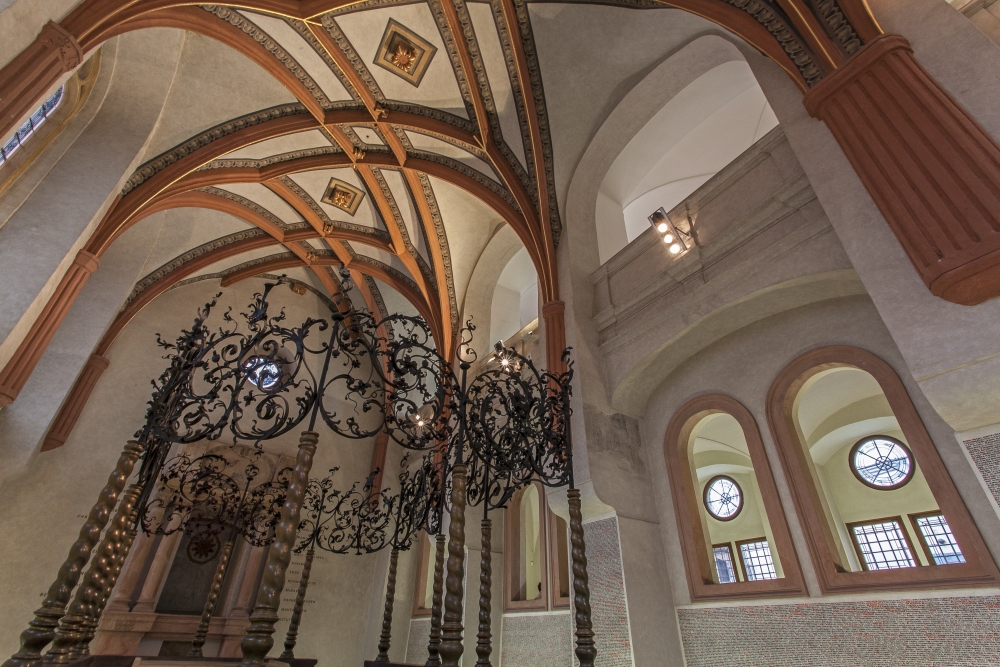
Pinkasova synagoga / Pinkas Synagogue
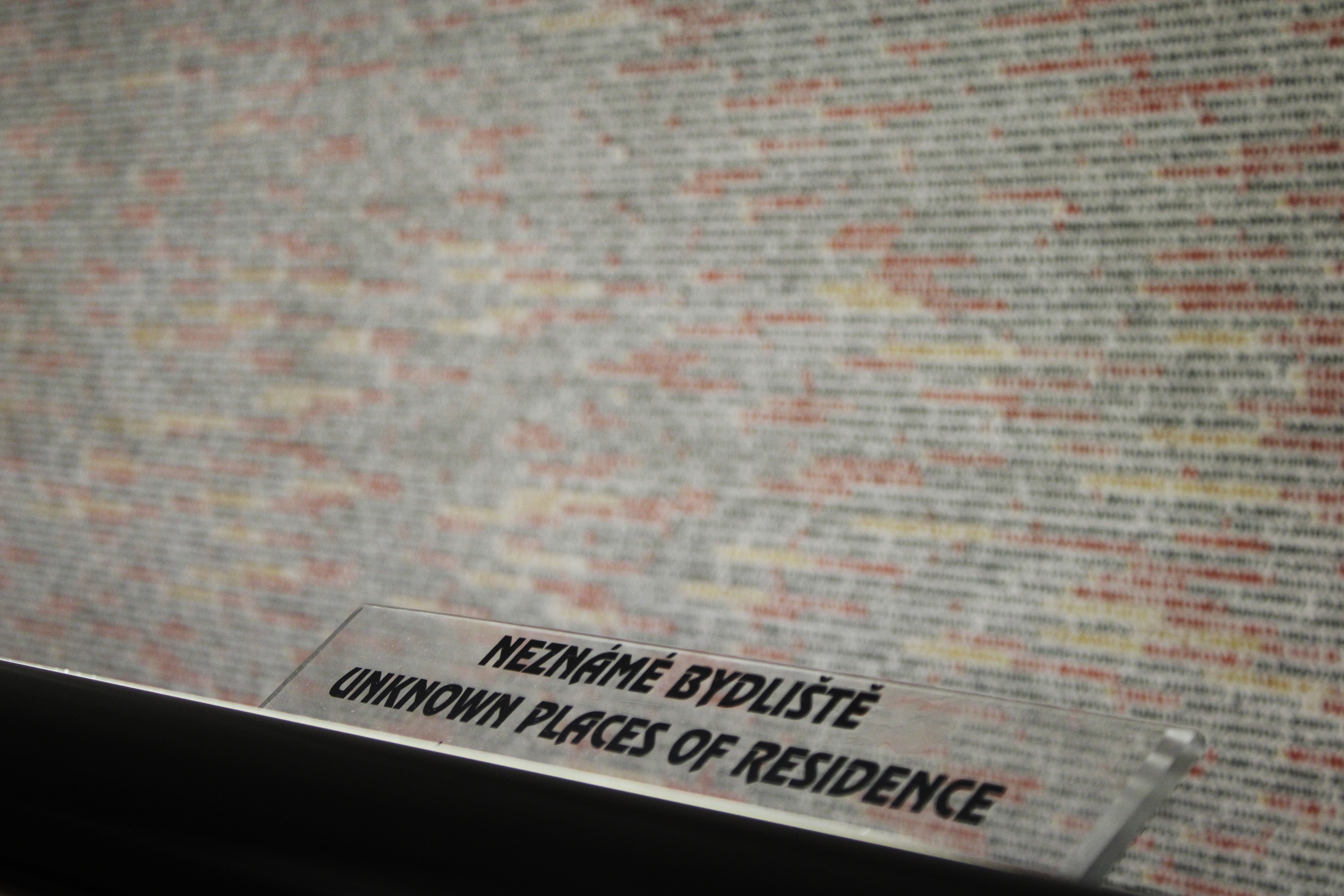
Pinkasova synagoga / Pinkas Synagogue
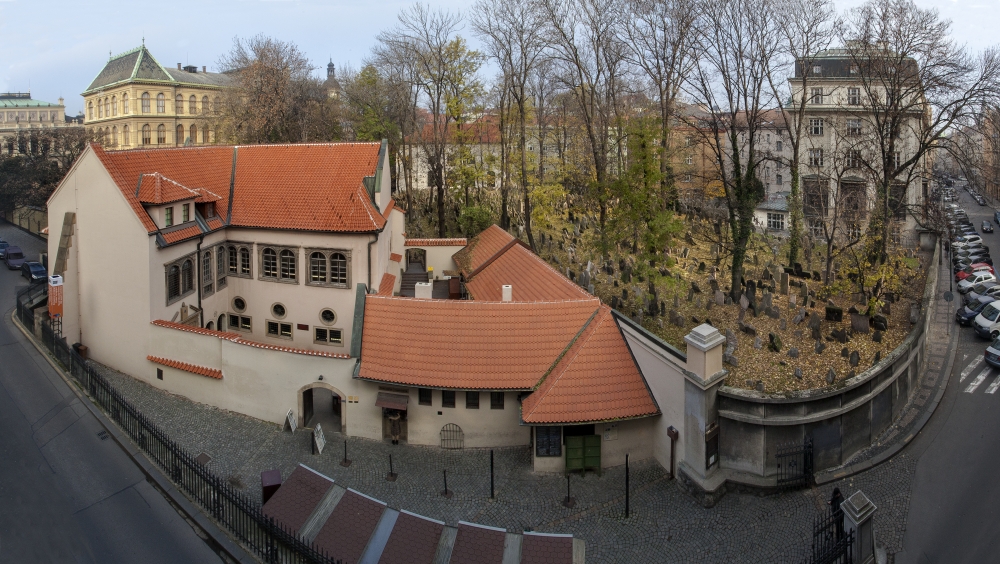
Pinkasova synagoga / Pinkas Synagogue
![[design/2013/breadcrumb-arrow.png]](https://c.jewishmuseum.cz/images/design/2013/breadcrumb-arrow.png)
![[design/2013/fb-icon.jpg]](https://c.jewishmuseum.cz/images/design/2013/fb-icon.jpg)
![[design/2013/youtube-icon.png]](https://c.jewishmuseum.cz/images/design/2013/youtube-icon.png)
![[design/2013/Twitter.png]](https://c.jewishmuseum.cz/images/design/2013/Twitter.png)
![[design/2013/Instagram.png]](https://c.jewishmuseum.cz/images/design/2013/Instagram.png)

![[Incident2.png]](https://c.jewishmuseum.cz/images/Incident2.png)
![[homepage-banner/ENGbannerKohlovadiscount2018.jpg]](https://c.jewishmuseum.cz/images/homepage-banner/ENGbannerKohlovadiscount2018.jpg)