

![[subpage-banner/6_Media.png]](https://c.jewishmuseum.cz/images/subpage-banner/6_Media.png)
Welcome to the Jewish Museum in Prague!
The Jewish Museum in Prague is the third oldest of its kind in the world – not a single building, but a remarkable ensemble of
historic synagogues, monuments, and exhibitions located in the former Jewish Quarter, Josefov, in Prague’s Old Town.
With the Prague Jewish Town Ticket, visitors gain access to the most iconic sites of Jewish history and culture, including:
-> Old-New Synagogue – the oldest active synagogue in Europe.
-> Old Jewish Cemetery – one of the most evocative historic burial sites in the world
-> Spanish Synagogue – a stunning example of Moorish Revival architecture
Whether you’re a history enthusiast, architecture lover, or curious traveler, this immersive experience offers a profound
connection to centuries of Jewish life, resilience, and tradition.
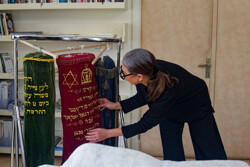
Thirty-Nine Precious Synagogue Textiles Find Their Way Home after More Than Eighty Years
February 18, 2026 – The Federation of Jewish Communities in the Czech Republic, in close cooperation with the Jewish Museum in Prague, is working to right a long-standing historical wrong. A remarkable group of synagogue textiles—part of the cultural heritage of Jewish communities in what is now Greece, looted by the Nazis during the Second World War—is now being returned to its country of origin. The unique relic of the Greek Sephardic Jewish community was received on 17 February 2026 by Zanet Battinou, Director of the Jewish Museum of Greece, from representatives of the Federation of Jewish Communities in the Czech Republic and the Jewish Museum in Prague.
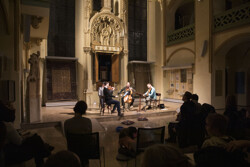
Opening the World of Art to People with Dementia: Unique Sensory Concerts Break Down Cultural Barriers
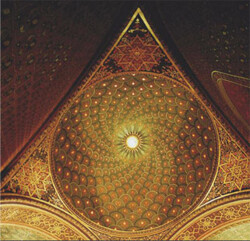
Top Things to See at the Jewish Museum in Prague
The Jewish Museum in Prague is not a single building, but a collection of historic sites across the Jewish Quarter. Visitors can enter the Old-New Synagogue, walk among the gravestones of the Old Jewish Cemetery, read the names of Holocaust victims in the Pinkas Synagogue, and admire the richly decorated Spanish Synagogue. Together with exhibitions in the Maisel and Klausen Synagogues and the Ceremonial Hall, these places reveal both famous highlights and lesser-known aspects of Jewish life in Prague.
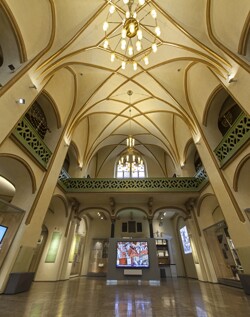
Hate crowds? The best time to Visit the Jewish Museum in Prague!
This season offers an excellent opportunity to visit the Jewish Museum in Prague without long queues or crowds. Visitor numbers are generally lower in January - mid-March period, allowing for a calmer and more comfortable experience.
All synagogues and museum buildings are heated, making visits pleasant even in colder weather. The quieter atmosphere also allows visitors to spend more time exploring the exhibitions, the Old Jewish Cemetery, and the historic synagogues at an unhurried pace.
Winter and early spring are therefore an ideal time to experience the Jewish Museum in Prague in peace and without rush.
Visitors interested in a deeper insight can choose their guided tour HERE.
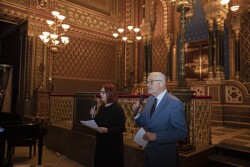
Holocaust Remembrance Day: Remembering the Names, the Lives, and the Silence
Holocaust Remembrance Day is not marked by celebration or spectacle. It is a day of pause — a moment set aside to remember
six million Jewish men, women, and children whose lives were destroyed, and to reflect on what remains when voices are silenced
and entire worlds erased.
In Prague, remembrance carries particular weight. The city’s synagogues, cemetery, and memorial spaces bear witness to
centuries of Jewish life — and to the devastating rupture caused by the Holocaust. To remember here is not abstract; it
is rooted in names, places, and absence.
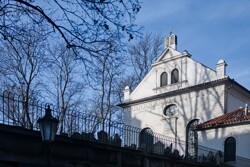
10 Guided Tours in Prague You Shouldn’t Miss
Prague, December 11 - Prague is a city best discovered step by step — or, at times, from the quiet surface of the Vltava River. Its squares, alleys, bridges, and riverbanks hold centuries of history, each layer brought to life by an expert guide. For visitors drawn to the past — to architecture, Jewish heritage, royal traditions, or the city’s hidden historical corners — these ten guided tours offer some of the most insightful ways to experience the Czech capital.
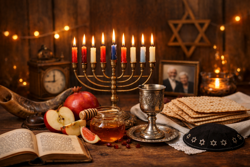
Jewish Holidays: Time, Memory, and Tradition (2026)
Jewish holidays are not merely dates marked in a calendar. They are moments when time itself becomes meaningful — when history, faith, memory, and daily life intersect. Throughout the Jewish year, festivals and commemorative days form a rhythm shaped by joy and mourning, freedom and responsibility, renewal and remembrance.
Rather than commemorating the past from a distance, Jewish holidays invite participants to relive and transmit memory through ritual, storytelling, food, prayer, and community. In this way, time becomes a vessel of heritage.
Kabbalah in Prague: Sefirot, the Golem, and the Lost City of Josefov
For centuries, Prague was regarded as one of Europe’s great centres of Jewish mysticism. Beneath its synagogues, narrow streets, and medieval courtyards, a deeper spiritual map was imagined — one shaped by Kabbalah, the mystical tradition of Judaism, and by the symbolic structure known as the sefirot.
This invisible architecture gave meaning to the physical city. Yet much of the world in which it arose vanished during the dramatic urban transformation of the late 19th century, when the old Jewish Town of Josefov was largely demolished in a process known as the Prague Asanation. What survived was not only a handful of buildings, but a powerful cultural memory.
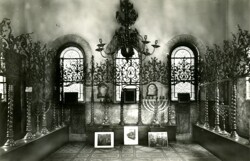
Never Alone: The Burial Brotherhood and Jewish Funeral Rituals in Prague
In Jewish tradition, no one should ever be left alone at the end of life — nor after it. This principle lies at the heart of the Burial Brotherhood, known in Hebrew as Chevra kadiša (חֶבְרָה קַדִּישָׁא), one of the most important and compassionate institutions in Jewish communal life. In Prague, its history stretches back centuries and is inseparably connected with the Old Jewish Cemetery, the Ceremonial Hall, the Klausen Synagogue, and Maisel Street.
![[design/2013/breadcrumb-arrow.png]](https://c.jewishmuseum.cz/images/design/2013/breadcrumb-arrow.png)
![[design/2013/fb-icon.jpg]](https://c.jewishmuseum.cz/images/design/2013/fb-icon.jpg)
![[design/2013/youtube-icon.png]](https://c.jewishmuseum.cz/images/design/2013/youtube-icon.png)
![[design/2013/Twitter.png]](https://c.jewishmuseum.cz/images/design/2013/Twitter.png)
![[design/2013/Instagram.png]](https://c.jewishmuseum.cz/images/design/2013/Instagram.png)

![[Incident2.png]](https://c.jewishmuseum.cz/images/Incident2.png)