.png)
- Památky a expozice
- Program a vzdělávání
- Sbírky a výzkum
- Sbírky a fondy
- Textil
- Kovy a 3D předměty
- Vizuální umění
- Rukopisy a nálezy z geniz na papíře
- Vzácné tisky
- Archiv
- Dokumentace šoa
- Sbírka Rozhovory s pamětníky
- Fotoarchiv
- Péče o sbírky
- Restaurátorské dílny
- Výpůjčky předmětů ze sbírkového fondu Židovského muzea v Praze
- Dary a akvizice
- Kabinet Friedl
- Osvědčení k vývozu předmětu kulturní hodnoty
- Provenienční výzkum a bezúplatné převody ze sbírek ŽMP
- Digitální sbírky
- Věda a výzkum
- Sbírky a fondy
- Zapojte se
- Média

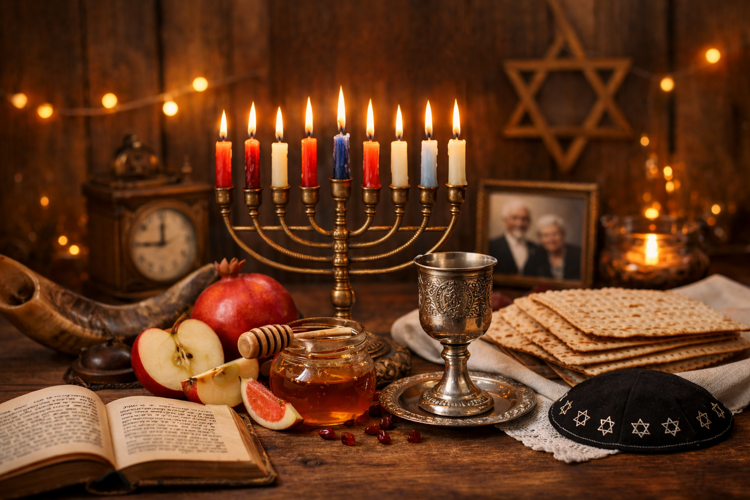
Jewish Holidays: Time, Memory, and Tradition (2026)
Jewish holidays are not merely dates marked in a calendar. They are moments when time itself becomes meaningful — when history, faith, memory, and daily life intersect. Throughout the Jewish year, festivals and commemorative days form a rhythm shaped by joy and mourning, freedom and responsibility, renewal and remembrance.
Rather than commemorating the past from a distance, Jewish holidays invite participants to relive and transmit memory through ritual, storytelling, food, prayer, and community. In this way, time becomes a vessel of heritage.
Understanding Jewish Holiday Dates
Jewish holidays are dated according to the Hebrew calendar, which is lunisolar — based on both the lunar cycle and the solar year. As a result, Jewish holidays do not fall on the same Gregorian date each year, though they consistently occur within the same seasonal period.
In Jewish tradition:
-
the day begins at sunset, not at midnight,
-
months follow the lunar cycle,
-
leap years are added to keep festivals aligned with the seasons.
In this article, each holiday is therefore presented with:
-
its Hebrew calendar date, and
-
the exact Gregorian date for the year 2026, with the understanding that observance begins at sunset on the evening before the stated date.
The Cycle of Jewish Holidays in 2026
Rosh Hashanah – The Jewish New Year
Hebrew date: 1–2 Tishrei 5787
Gregorian date: evening of 11 September to nightfall on 13 September 2026
Rosh Hashanah marks the beginning of the Jewish year and the start of a period of introspection. The sounding of the shofar calls individuals and communities to reflect on their actions and responsibilities. It is a time of renewal rather than celebration alone.
Yom Kippur – The Day of Atonement
Hebrew date: 10 Tishrei 5787
Gregorian date: evening of 20 September to nightfall on 21 September 2026
Yom Kippur is the most solemn day of the Jewish year. Observed through fasting, prayer, and repentance, it is devoted to reconciliation — with others and with oneself. The day emphasizes moral accountability and the possibility of change.
Sukkot – The Festival of Booths
Hebrew date: 15–21 Tishrei 5787
Gregorian date: evening of 25 September to nightfall on 2 October 2026
Sukkot recalls the temporary dwellings used during the Israelites’ journey through the wilderness. Families build sukkot, fragile structures symbolizing impermanence, trust, and gratitude. The festival combines historical memory with agricultural tradition.
Shemini Atzeret and Simchat Torah
Hebrew date: 22–23 Tishrei 5787
Gregorian date: 2–4 October 2026
These days conclude the Sukkot cycle. Simchat Torah celebrates the completion and renewal of the annual Torah reading, highlighting study, continuity, and communal joy.
Hanukkah – The Festival of Lights
Hebrew date: 25 Kislev – 2/3 Tevet 5787
Gregorian date: evening of 4 December to nightfall on 12 December 2026
Hanukkah commemorates the rededication of the Temple in Jerusalem in the 2nd century BCE. The lighting of candles over eight nights symbolizes endurance, faith, and the preservation of identity across generations.
Tu BiShvat – The New Year of the Trees
Hebrew date: 15 Shevat 5786
Gregorian date: 2 February 2026
Originally connected to agricultural law, Tu BiShvat later acquired symbolic meaning related to nature, growth, and renewal. Today it is often associated with environmental awareness.
Purim – Memory and Survival
Hebrew date: 14 Adar 5786
Gregorian date: evening of 2 March to nightfall on 3 March 2026
Purim recalls the events described in the Book of Esther, celebrating the survival of the Jewish community in ancient Persia. It is marked by storytelling, charity, and joy, underscoring themes of identity and resilience.
Passover (Pesach) – Freedom and Responsibility
Hebrew date: 15–22 Nisan 5786
Gregorian date: evening of 1 April to nightfall on 9 April 2026
Passover commemorates the Exodus from Egypt. Central to the festival is the Seder, a ritual meal structured around questions, symbolic foods, and storytelling. The holiday emphasizes that freedom carries responsibility and must be renewed in every generation.
Yom HaShoah – Holocaust Remembrance Day
Hebrew date: 27 Nisan 5786
Gregorian date: evening of 13 April to nightfall on 14 April 2026
Yom HaShoah honors the victims of the Holocaust and the survivors who carried memory forward. Remembrance is expressed through names, testimony, silence, and education.
Shavuot – Revelation and Learning
Hebrew date: 6–7 Sivan 5786
Gregorian date: evening of 21 May to nightfall on 23 May 2026
Shavuot marks the giving of the Torah at Mount Sinai. It celebrates learning, study, and the covenant between God and the people of Israel. Night-long study and dairy foods are traditional elements.
Tisha B’Av – A Day of Mourning
Hebrew date: 9 Av 5786
Gregorian date: evening of 22 July to nightfall on 23 July 2026
Tisha B’Av commemorates the destruction of the First and Second Temples and other collective tragedies. It is observed through fasting and reflection on loss, exile, and historical rupture.
Shared Meaning Across the Calendar
Across the Jewish year, recurring elements appear: symbolic foods, prayer, family gatherings, storytelling, and communal memory. Holidays are observed both in the synagogue and at home, reinforcing the connection between sacred tradition and everyday life.
Jewish Holidays Today
Today, Jewish holidays are observed in diverse ways — religious, cultural, and educational. In cities such as Prague, institutions like the Jewish Museum in Prague help present these traditions to both Jewish and non-Jewish audiences, preserving them as living expressions of heritage.
Why Jewish Holidays Matter
Jewish holidays transform time into memory and repetition into continuity. Through their annual return, they connect generations and affirm identity — not as something static, but as something continually renewed.
Frequently Asked Questions
Why do Jewish holidays begin at sunset?
Because the Jewish day follows the biblical concept that evening precedes morning.
Why do the dates change every year?
Because the Hebrew calendar is lunisolar and differs from the Gregorian calendar.
Are all Jewish holidays religious?
Some are religious, others historical or commemorative, but all carry cultural significance.
Can visitors experience Jewish holidays today?
Yes. Through exhibitions, educational programs, and public events, many aspects are accessible to visitors.
Sources
![[Incident2.png]](https://c.jewishmuseum.cz/images/Incident2.png)

![[homepage-banner/CZbannerKohlovadiscount2018.jpg]](https://c.jewishmuseum.cz/images/homepage-banner/CZbannerKohlovadiscount2018.jpg)