.png)
- Památky a expozice
- Program a vzdělávání
- Sbírky a výzkum
- Sbírky a fondy
- Textil
- Kovy a 3D předměty
- Vizuální umění
- Rukopisy a nálezy z geniz na papíře
- Vzácné tisky
- Archiv
- Dokumentace šoa
- Sbírka Rozhovory s pamětníky
- Fotoarchiv
- Péče o sbírky
- Restaurátorské dílny
- Výpůjčky předmětů ze sbírkového fondu Židovského muzea v Praze
- Dary a akvizice
- Kabinet Friedl
- Osvědčení k vývozu předmětu kulturní hodnoty
- Provenienční výzkum a bezúplatné převody ze sbírek ŽMP
- Digitální sbírky
- Věda a výzkum
- Sbírky a fondy
- Zapojte se
- Média

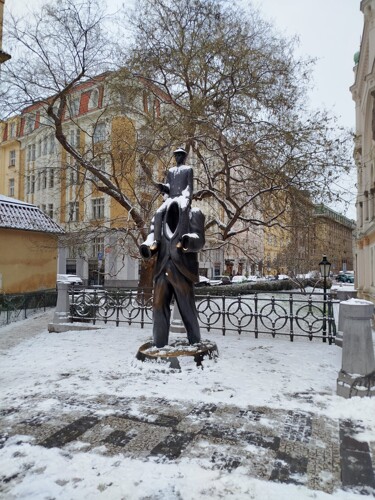
Franz Kafka in Prague: Traces of the Famous Writer
02.02.2026
- 02.02.2026
Kafka’s Early Life and the City That Formed Him
Born in 1883 into a German-speaking Jewish family, Kafka grew up in Prague’s Old Town, a short walk from the synagogues and cemeteries of Josefov. His daily life unfolded between family expectations, academic ambitions, and a demanding office job at an insurance institute.
Prague at the turn of the century was a city of contrasts—imperial elegance beside medieval streets, multilingual coexistence beside rising tensions. Kafka absorbed all of this: its beauty, its strangeness, its instability. The city became not just a backdrop, but a psychological landscape that shaped his major works.
Kafka’s Prague: Places That Still Carry His Imprint
-
Old Town Square
Kafka lived and studied close to this square, whose shifting crowds and monumental facades inform the sense of spectacle and unease in his writing.
-
Josefov (the Jewish Quarter)
While Kafka did not reside there long-term, Josefov’s cultural world—its synagogues, rituals, and atmosphere of both belonging and difference—shaped the background of his identity as a Prague Jew.
-
Na Poříčí 23 – Workers’ Accident Insurance Institute
Here Kafka worked for over a decade. The duality between bureaucratic order and inner turmoil plays a central role in works like The Trial.
-
Prague’s cafés
Café Arco and others offered intellectual refuge: a place where Kafka observed, wrote, and debated with Prague’s literary circle.
These places remain visible today, allowing readers to trace not only his footsteps but the moods that animated his fiction.
Franz (2025): A New Cinematic Portrait
Agnieszka Holland’s film Franz approaches Kafka’s life through poetic fragmentation—echoing the ambiguity of his prose. Premiering in 2025 and selected for competition at the San Sebastián International Film Festival, the film returns Kafka’s story to Prague’s global audience.
Rather than presenting a conventional biography, Holland layers memory, dream, and historical reconstruction, making the film a companion to Prague itself: a place where many eras coexist in one moment.
Why Kafka Still Belongs to Prague
Kafka believed that “a city can be read,” and Prague, with its mixture of cultures and centuries, became the text he never stopped deciphering.
-
Its symbolic architecture echoes in his shifting corridors and endless stairways.
-
Its Jewish history resonates in his themes of identity and responsibility.
-
Its bureaucratic machinery shaped his metaphors of power and alienation.
Even today, Kafka’s presence is felt not in monuments alone but in the quiet spaces between them.
Visiting Kafka’s Prague Today
To explore Kafka’s world:
-
Begin in the Old Town and follow plaques marking his former homes and schools.
-
Visit the Franz Kafka Museum on Cihelná Street, where manuscripts and multimedia exhibitions evoke the dreamlike texture of his work.
-
Walk slowly—Kafka’s Prague is best found in observation, not speed.
-
See Holland’s Franz for a contemporary artistic reflection on the life that unfolded among these streets.
Frequently Asked Questions
Where was Franz Kafka born?
In Prague’s Old Town, near today’s Kinský Palace, in 1883.
Did Kafka have strong ties to the Jewish Quarter?
Yes, culturally and religiously. While he moved within various parts of the Old Town, Josefov formed part of his family’s
communal environment and heritage.
What is the Franz Kafka Museum?
A museum in Malá Strana that presents Kafka’s manuscripts, letters, and immersive exhibitions reflecting his distinctive
literary world.
What is the new film Franz about?
Directed by Agnieszka Holland, it traces Kafka’s life from Prague to Vienna, blending biography with poetic imagery.
Can visitors follow a Kafka walking trail in Prague?
Yes. Several mapped routes and guided tours lead through Kafka’s homes, schools, favourite cafés, and workplaces.
Is Kafka considered a “Prague writer”?
Absolutely. His work cannot be separated from the city’s atmosphere, languages, and historical anxieties.
Sources
https://en.wikipedia.org/wiki/Franz_(2025_film)
Author
This article was prepared by the team at the Jewish Museum in Prague, which has been preserving Jewish heritage since 1906. The museum holds one of the most extensive collections of Judaica in the world outside of Israel. Through exhibitions, publications, and educational programs, our mission is to promote understanding of Jewish history, culture, and traditions — both in the Czech Republic and globally.
![[Incident2.png]](https://c.jewishmuseum.cz/images/Incident2.png)