.png)

![[subpage-banner/6_Media.png]](https://c.jewishmuseum.cz/images/subpage-banner/6_Media.png)
Ilona Singer-Weinberger: Girl with Forsythia
června 2015
Ilona Singer-Weinberger (June 8, 1905, Budapest – after May 15, 1944, Auschwitz)
Girl with Forsythia, 1930
Catalogued in the JMP’s collection on July 5, 1944, selected from the warehouse of the Prague Treuhandstelle, last owner before confiscation: Margita Hahnová, Prague
Visual Arts Collection
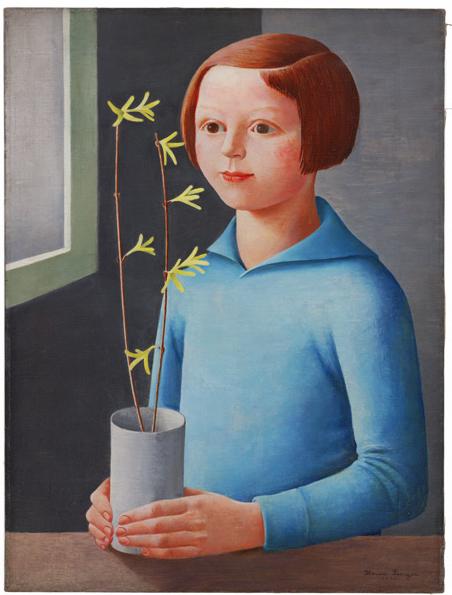
Ilona Singer-Weinberger: Girl with Forsythia, JMP 82.438 Oil on canvas, 60 x 45 cm Signed and dated lower right: Ilona Singer / 1930
The beginning of June 2015 marks 110 years since the birth of painter Ilona Singer. During her short life, tragically ended in an Auschwitz gas chamber, she managed to attract the attention of a small circle of admirers and supporters of interwar modern art.
Ilona Singer was born into a Jewish family as the youngest of two daughters of merchant Arnold Singer and his wife, Emilie, née Rindler. Although the Singers’ registered domicile was Nové Strašecí near the town of Slaný, they spent much of their time outside of Bohemia – first in Budapest, where both daughters were born, and later in Offenbach near Darmstadt, where the elder sister, Margita, was married to Leopold Hahn, who worked as a procurement clerk for the firm of Hammel & Rosenfeld.
From 1923 to 1925 Ilona Singer studied at a United State School for Free and Applied Art in Berlin, a progressive educational institution whose program closely resembled the State Bauhaus and other experimental teaching at like-minded art schools in the young Weimar Republic. Evidently it was here she adopted a pared-down style for her art under the influence of the prevailing New Objectivity (Neue Sachlichkeit), to which she remained faithful over her short professional career.
Ilona’s life from the time she finished her studies until 1936 can be partially reconstructed from the extant Prague Police Directorate records in the Czech National Archives. These bare official records (generally requests for travel documents) show that her permanent address was Berlin and she took several study trips to Switzerland, Italy, and France. From August 1925 to the beginning of May 1926 she resided in Rome, likely also for study purposes, and from that time on she regularly visited Italy. In 1929 her widowed mother, Emilie, and sister, Margita, with her son, Jan, moved to Prague, living at Holečkova 8, Smíchov. Though this also became Ilona’s registered address, she stayed in Berlin instead and actively traveled. There is no mention of her in the Prague Police Directorate records after 1936 although her family continued to live in Prague.
From the testimony given by Ilona’s cousin Gitta Treital to the Yad Vashem memorial in Jerusalem and corroborated by information in the Terezín Initiative Institute’s database, Ilona married Felix Weinberger in the late 1930s. The couple then moved to Hodonín, from where she was deported with her entire new family to Terezín (on transport “Co” that was dispatched from Uherský Brod on January 27, 1943). In Terezín she was reunited with her sister and nephew. They were deported from Prague in July of that year after many failed attempts to obtain permission to move to Shanghai and to postpone deportation. They were not in time to see their mother in Terezín, however, as she had already been deported to Treblinka in October 1942. In May 1944 they all were on transports to the death camp at Auschwitz. Margita and Jan Hahn were transported on May 15, and Ilona and Felix Weinberger followed three days later. There is no trace of them after this.
Only a handful of oil paintings is all we have of Ilona Singer’s work today. Over the latter half of 1944 five paintings eventually came into the collection of the former Central Jewish Museum (today the Jewish Museum in Prague) after being selected from the Prague Treuhandstelle, whose mission was to liquidate the property left behind in the apartments of those persons deported from Prague and its environs. Three of these paintings – Girl with Forsythia(1930), Man with Cigarette (1928), and Boy with Teddy Bear (1927) – were taken from the apartment of her sister, Margita. Another, Portrait of a Man with a Red Tie (1930), was confiscated from Josef Singer of Prague, who also died in Auschwitz after being deported at the end of 1943. Unfortunately, for the painting catalogued in the Jewish Museum’s collection as Still Life with Exotic Plants (Cacti) no precise provenance data has thus far been found that would allow identification of the last owner prior to confiscation.
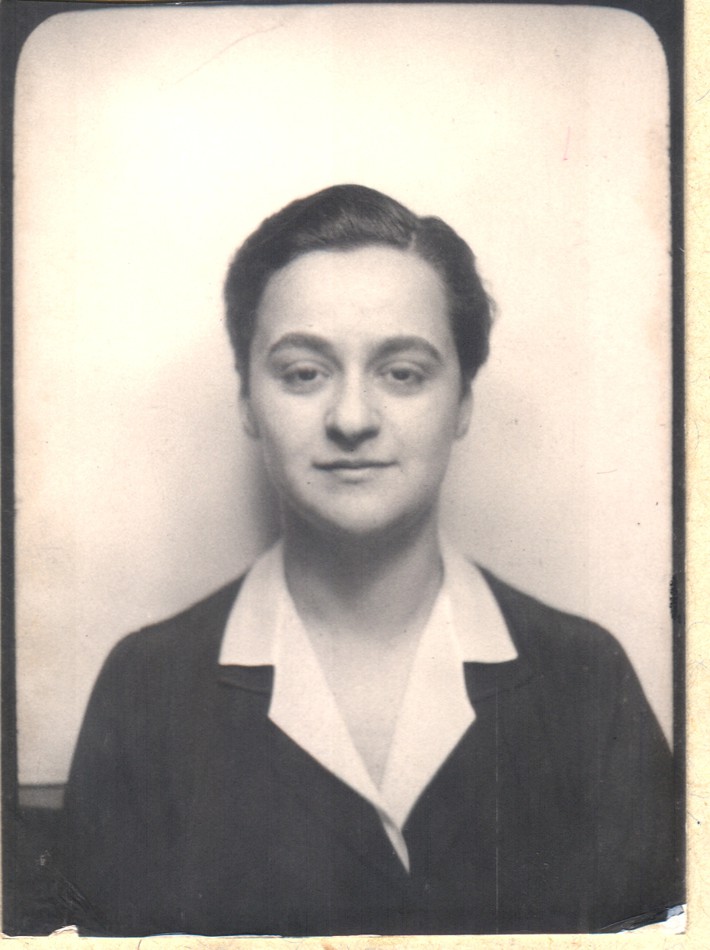
Ilona Singer (1905-1944), c. 1932

Margita Hahn (1902-1944), c. 1929
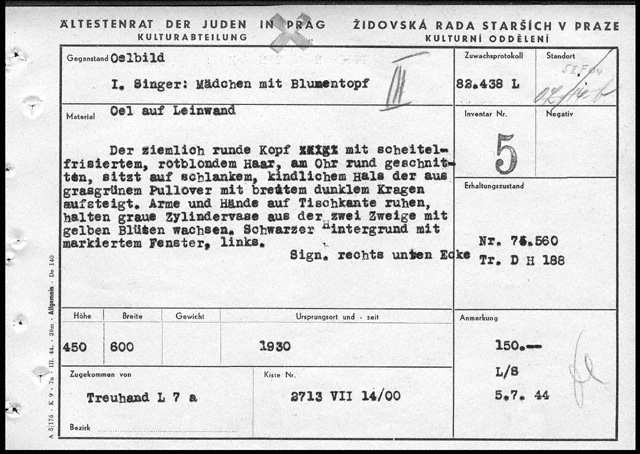
Catalogue card of the Central Jewish Museum in Prague giving the transport number Dh 188 identifying Margita Hahn as the last owner of the painting before its liquidation by the Prague Treuhandstelle.
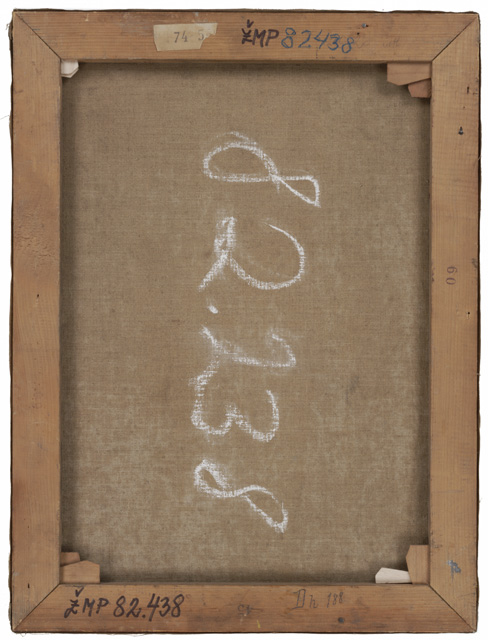
Ilona Singer: Girl with Forsythia; reverse side of the painting bears the transport number Dh 188, under which Ilona’s sister, Margita Hahn, was deported from Prague to Terezín on July 8, 1943; the number is written in pencil on the bottom stretcher slat.
![[design/2013/breadcrumb-arrow.png]](https://c.jewishmuseum.cz/images/design/2013/breadcrumb-arrow.png)
![[Incident2.png]](https://c.jewishmuseum.cz/images/Incident2.png)

![[homepage-banner/CZbannerKohlovadiscount2018.jpg]](https://c.jewishmuseum.cz/images/homepage-banner/CZbannerKohlovadiscount2018.jpg)